We give a generalization of the result of [GHK22, Proposition 4.4.5].
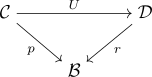
Proposition 1.1. Given a diagram
| (1) |
in such that:
- (i)
-
and are coCartesian fibrations and preserves coCartesian edges;
- (ii)
-
has a left adjoint such that ;
- (iii)
-
The adjunction restricts in each fiber to an adjunction . For all , the functor is conservative, and admits colimits of -split simplicial objects, which preserves.
- (iv)
-
For any edge in , the coCartesian covariant transport preserves geometric realizations of -split simplicial objects.
Then, the adjunction is monadic.
Remark 1.2. In view of the Barr–Beck–Lurie theorem, condition (iii) in Proposition 1.1 is equivalent to:
- (iii)
-
The adjunction restricts in each fiber to a monadic adjunction .
Proof of Proposition 1.1. We verify the conditions of the Barr–Beck–Lurie theorem [Lur17, Theorem 4.7.3.5].
First we show that is conservative. We can argue in exactly the same way as [GHK22, Proposition 4.4.5]. Suppose that is a morphism in such that is an equivalence in . Then is an equivalence in . One can factor as where is a coCartesian lift of and is a morphism in the fiber above . Since is coCartesian lift of an equivalence, it is an equivalence. Because of the fiberwise monadicity assumption (iii), is an equivalence. Therefore is an equivalence and is conservative.
Now we will show that admits and preserves colimits of -split simplicial objects. Let be a -split simplicial object, so that extends to a diagram . Let be the underlying diagram in . There is a morphism
| (2) |
which is the identity on and carries to . It sends each horizontal morphism to the unique morphism . Consider the composite
| (3) |
Now we will take a coCartesian lifts, using the exponentiation for coCartesian fibrations [Lur18, Tag 01VG].
- Let be a coCartesian lift of to . Then is a natural transformation between and a morphism , where is the image under of .
- Let be a coCartesian lift of to . Then is a natural transformation between and a morphism .
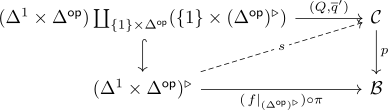
These natural transformations and are uniquely characterised by the property that their components are coCartesian edges [Lur18, Tag 01VG]. Because of the assumption (i) that preserves coCartesian edges, this unicity implies that . In particular extends to the split simplicial object . By the fiberwise monadicity assumption (iii), this implies that extends to a colimit diagram such that is also a colimit diagram. By assumption (iv) and [Lur09, Proposition 4.3.1.10] it then follows that and , when regarded as diagrams in and respectively, are -colimit diagrams. Now we can argue as in [Lur09, Corollary 4.3.1.11]. We have a commutative diagram
| (4) |
in which denotes the morphism which is the identity on and which carries to the cone point. Because the left map is an inner fibration there exists a lift as indicated by the dashed arrow. Consider now the map which is the identity on and carries the other vertices of to the cone point. Let denote the composition
| (5) |
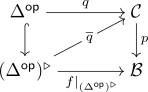
and define . Then is a natural transformation from to which is componentwise coCartesian. Then [Lur09, Proposition 4.3.1.9] implies that is a -colimit diagram which fits into the diagram
| (6) |
By assumption (i), is a natural transformation from to which is componentwise coCartesian. Hence [Lur09, Proposition 4.3.1.9] implies that is a -colimit diagram. The underlying diagram of in extends to the split simplicial diagram and hence admits a colimit in . Hence [Lur09, Proposition 4.3.1.5(2)] implies that and are colimit diagrams in and respectively. Hence admits and preserves geometric realizations of -split simplicial objects. □
References
[GHK22] David Gepner, Rune Haugseng, and Joachim Kock. -operads as analytic monads. Int. Math. Res. Not. IMRN, (16):12516–12624, 2022.
[Lur09] Jacob Lurie. Higher topos theory, volume 170 of Annals of Mathematics Studies. Princeton University Press, Princeton, NJ, 2009.
[Lur17] Jacob Lurie. Higher Algebra. Available at https://www.math.ias.edu/~lurie/papers/HA.pdf, 2017.
[Lur18] Jacob Lurie. Kerodon. https://kerodon.net, 2018.
Hi, this is a comment.
To get started with moderating, editing, and deleting comments, please visit the Comments screen in the dashboard.
Commenter avatars come from Gravatar.